Enter your email for a chance at
$1000
to use in the Special Learning Store!!
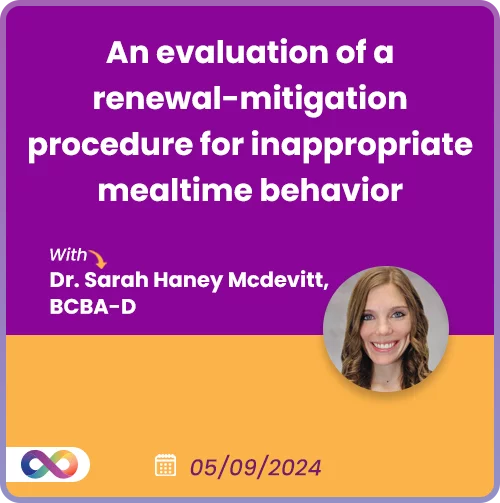
In this recorded Journal Club, Sarah Haney McDevitt examines renewal: the return of mealtime refusal after treatment when the context changes. With host Karen Chung, she reviews a seven-child study of feeder, food and setting changes, caregiver training, and the limits of renewal-mitigation procedures.
Presenter credits: Dr Sarah Haney.
MANDATORY DISCLAIMER: The Behavior Analyst Certification Board (“BACB”) does not sponsor, approve or endorse Special Learning, the materials, information, or sessions identified herein.
For cancellations and refunds, please see our policy HERE.
McDevitt reviews pediatric feeding disorders and the ABA, ABC and AAB renewal arrangements, then walks through the study's control and mitigation conditions. The examples include gradually introducing the caregiver as feeder, fading foods, and making the clinic resemble a home meal setting.
She distinguishes variable caregiver-fading findings from the individual setting-change cases and explains carryover and component-analysis limitations. In the closing discussion, Karen Chung asks about feeding services; McDevitt describes multidisciplinary roles and emphasizes training, supervision and ongoing guidance, including a caution about escape extinction in general ABA clinics.
Recording context: The study involved seven children in an intensive day-treatment programme. Its individual setting-change cases are not population estimates.
Special Learning's course evaluation snapshot contains 0 rating responses for this recording. No rating average is shown, and no anonymous learner comment is reproduced here. Source: course evaluation records, October 11, 2026.